
SEN Pushchairs and Buggies for Autistic Children: An Honest UK Parent Guide
- Ergoadaptive Go Team

- Aug 8
- 8 min read

SEN Pushchairs and Buggies for Autistic Children: An Honest UK Parent Guide
If you've started looking into SEN pushchairs or buggies for an autistic child, you've probably already found that the information available ranges from helpful to bewildering. Product descriptions all sound similar. Price differences aren't always explained. And the most important question, whether a specific pushchair will actually work for your specific child, is almost impossible to answer from a product page alone.
This guide cuts through that confusion. It covers what SEN pushchairs and buggies actually are, who needs them, what to look for, and how to access funding. It's written for parents who are doing serious research, including those wondering whether their autistic child really needs one and those who already know they do and want to choose well.
For a complete overview of the selection process, read our complete guide to choosing a pushchair for an autistic child.
What Is an SEN Pushchair or Buggy?
The terms SEN pushchair, SEN buggy, adaptive pushchair, disability buggy and specialist pushchair are often used interchangeably. They all refer to the same category: pushchairs designed and engineered for children whose needs fall outside what standard infant or toddler pushchairs are built to handle.
Standard pushchairs are designed for typically developing children up to around 25kg and three or four years of age. They assume a child who sits cooperatively, doesn't exert significant force, doesn't need help managing sensory input, and will gradually reduce their pushchair use as they learn to walk independently.
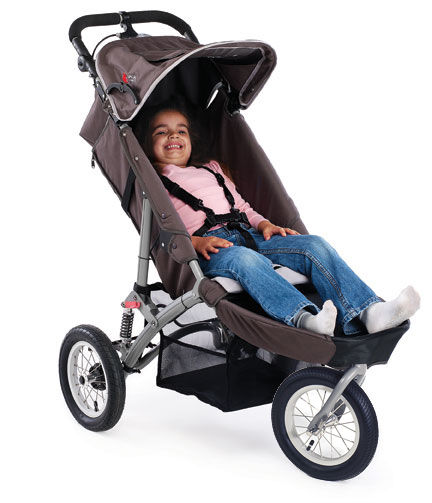
SEN pushchairs are built around a fundamentally different set of assumptions. They are designed for children who may be older or larger, who may have complex postural needs, who may actively attempt to escape standard harness systems, who generate significant force through rocking or physical agitation, or who need a consistent, structured sensory environment during outings. The engineering required to meet those needs is genuinely more complex, and that complexity is reflected in the design and price.
Why Autistic Children Often Need a Buggy Beyond the Toddler Years
One thing to say clearly from the start: if you're researching buggies for an older autistic child, you are not alone and you are not doing something unusual. Many autistic children need mobility support well beyond the age at which neurotypical children stop using pushchairs. The reasons are practical, not sentimental.
Danger unawareness
Perhaps the most acute reason. Many autistic children develop later than their neurotypical peers, if at all, the instinctive understanding that traffic, heights, and open water are dangerous. A child who will run without warning toward a road, drawn by something on the other side, needs containment that ensures their safety in a way that supervision alone cannot guarantee. No carer, however attentive, can reliably prevent a fast-moving child from reaching a road if their only option is physical interception.
Sensory overload in community environments
Supermarkets, high streets, train stations, school runs, these are environments that most people navigate without significant difficulty. For autistic children, they can be genuinely overwhelming. The combination of unpredictable noise, movement in all directions, bright or flickering lights, and unexpected physical contact creates a sensory load that exceeds many children's regulatory capacity. When that threshold is crossed, the consequences, meltdowns, shutdowns, extreme distress, make continuing the outing impossible. A well-designed buggy provides a structured, lower-stimulation space that the child can use as a retreat without the outing having to end.
Fatigue
Navigating the neurotypical world takes sustained cognitive effort for autistic children. Processing sensory input, managing social demands, maintaining appropriate behaviour, suppressing instinctive responses, all of this happens continuously during every outing. The result is a level of fatigue that can arrive quickly and with little warning. A child who walked to school in the morning may simply be unable to walk home in the afternoon, not because they're being difficult, but because they're exhausted in a way that isn't always visible.
Who Might Need an SEN Pushchair?
The clearest indicator is when a child's current equipment, or no equipment at all, is no longer keeping them safe and comfortable during outings. For some families the trigger is a safety incident. For others it's gradual, the outings getting shorter, the routes getting narrower, the family slowly adapting around inadequate equipment.
If you're asking yourself honestly: can my child safely walk in busy environments without significant risk or distress? If the answer is no, or not reliably, then the need is present regardless of the child's age.
For more on the value of a specialist pushchair for daily family life, read our article on whether specialist pushchairs are worth it.
What a Good SEN Buggy Actually Provides
When families describe what changed after getting the right buggy for their autistic child, they consistently describe access rather than convenience. Not a slightly easier version of what they were already doing, a fundamentally different relationship with getting out.
Safety during outings that were previously too risky to attempt. School runs completed reliably rather than sporadically. Medical and therapeutic appointments attended rather than missed. Family days out lasting for hours rather than being abandoned after the first difficult moment. For families who have been narrowing their world around an autistic child's unmet mobility needs, the right buggy can reverse that narrowing significantly.
The Main Types of SEN Pushchair Available in the UK
Lightweight specialist pushchairs
The closest in appearance to a standard pushchair, but built to higher specifications: stronger frames, higher weight limits, and more robust harness systems. They are often the right starting point for younger children or those with less complex needs, and tend to be the most portable and transport-friendly option.
High-support or postural pushchairs
These prioritise structured seating, adjustable lateral supports, shaped seat bases, tilt-in-space functionality and headrests that keep a child correctly positioned for extended periods. Particularly relevant for children with physical conditions that affect muscle tone or trunk control, but also for children whose sensory profile means they need firm, consistent containment to feel regulated.
Safety-focused pushchairs
Harness security and frame strength are at the centre of their design. They typically feature child-resistant buckle systems, reinforced joints, and anti-tip designs specifically intended for children with absconding behaviour and higher physical output.
All-terrain pushchairs
Built for families who need to move across varied ground, parks, coastal paths, rougher urban surfaces, countryside walks. Larger wheels and improved suspension make terrain that would stop a standard pushchair manageable, and for children who find outdoor environments regulating, this can meaningfully expand what's accessible.
Harness Security: Getting This Right
For families with an autistic child who has any history of escape attempts or absconding behaviour, the harness system is the most important feature to get right. It is also the area where families most often start with insufficient equipment and upgrade later after a frightening incident.
A standard 5-point harness uses a central buckle that many motivated children can learn to release. For a child with strong absconding motivation, a standard buckle is not a significant barrier. Families have described children releasing standard harnesses in seconds in car parks, on busy pavements, at road crossings.
A 5-point harness with a child-resistant buckle raises that barrier substantially. The release mechanism requires a specific adult action that most children cannot replicate reliably. For children who have escaped standard buckles but whose escape risk is moderate, this is usually the right step up.
For children with significant absconding history or strong physical capability, a 7-point harness provides the highest level of containment currently available. The additional chest plate prevents the shoulder straps being pulled forward, the most common self-release technique, and the release sequence is adult-specific in a way that's very difficult for children to replicate.
Read our dedicated guide to secure pushchairs for autistic children for full detail on harness types.
Key Features to Understand
Understanding what each feature does, and whether it matters for your child, cuts through a lot of the confusion in SEN pushchair research.
● Weight capacity: the baseline requirement, but not the only sizing consideration. Seat width, depth, back height and footrest range all matter, and a child can outgrow a pushchair on any of these dimensions before exceeding its weight limit.
● Tilt-in-space: tilts the whole seating unit, seat and back together, changing the child's relationship to gravity without altering the angle between their body and their legs. For children who spend extended periods in the pushchair, this shifts pressure points, reduces fatigue and allows postural rest.
● Suspension and wheel size: determines how a pushchair handles real-world surfaces. Larger wheels and effective suspension absorb vibration and jarring from uneven ground, relevant not just for rough terrain but for the sensory experience of the child.
● Canopy coverage: how far forward and to the sides the canopy extends determines how much the child's visual field is reduced. A large canopy can meaningfully reduce the sensory load of busy outings.
● Lateral supports: padded supports on either side of the hips and torso prevent the child from leaning or slumping sideways, and provide proprioceptive containment that many autistic children find calming.
Our Range
The Axiom Lassen 2 is the most popular choice for daily urban use, combining a lightweight frame, compact fold, and child-resistant harness. It supports children up to 75kg and suits school runs, public transport, and most daily situations.
The Axiom Endeavour 2 adds tilt-in-space seating and enhanced lateral supports, making it the right choice for children who also have postural support needs alongside containment.
The Axiom Phoenix combines a compact, manoeuvrable design with strong security features and excellent canopy coverage.
The xRover Standard is built for outdoor and all-terrain use, with a 100kg weight limit, all-terrain wheels, and superior suspension. Right for families who regularly access parks, countryside, or varied terrain.
Use our find a pushchair tool to get a personalised recommendation, or contact our team for a free consultation.
SEN Pushchairs and Funding: The Honest Picture
One of the first questions families ask is whether they can get funding. The honest answer is: often yes, though rarely through the routes that seem most obvious. The NHS funds equipment through Community Equipment Services, but eligibility criteria are primarily built around physical mobility impairment. Autism, behavioural needs, or sensory requirements as a primary diagnosis typically don't qualify. This doesn't mean funding is unavailable, it means the most productive routes are elsewhere.
Charitable funding is where most UK families find genuine success. Both the organisations and the criteria vary, but professional letters from occupational therapists, paediatricians or specialist teachers carry significant weight. A parent statement that describes your child's daily life with specific real-life examples is equally important.
Disability Living Allowance, where a child is receiving it, can be used toward the cost without restriction. Many families use a blended approach, a charity grant covering the majority of the cost with DLA contributing toward accessories or a shortfall.
VAT exemption is also available on qualifying specialist disability equipment, which reduces the purchase price by 20%.
Visit our funding support page for free charity-matching and charity-ready quotes. Our
When Is the Right Time to Start Looking?
The answer is almost always: sooner than you think. Funding applications take time. Waiting lists for occupational therapist assessments can be long. And a child's needs don't pause while the paperwork catches up. The families who find the process most difficult are typically those who begin it in a crisis, a safety incident, a pushchair that's already too small, a school run that's become unmanageable. Starting early gives you time to gather evidence, understand the options, and approach funding from a position of preparation rather than urgency. If you're reading this because you're wondering whether your child might need an SEN pushchair, that wondering is itself a reasonable signal. It's worth exploring the question properly.
Continue Reading


Comments